


Des. by
R N
CASCADIA HIGH SPEED RAIL, LLC™
OPPORTUNITY
EXECUTIVE SUMMARY
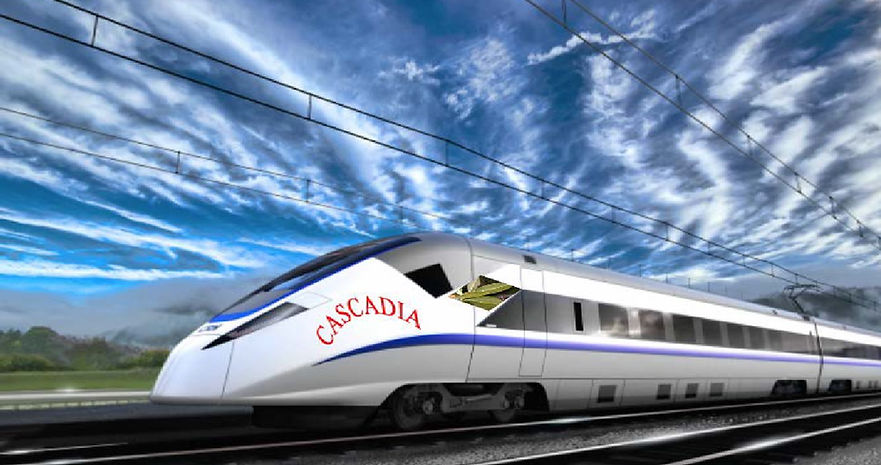
Since 2006 Cascadia High Speed Rail, LLC has been developing a high-speed rail system for the Eugene, Portland, Tacoma/Seattle, and Vancouver, BC corridor. The 413-mile Cascadia High Speed Rail (CHSR) corridor has been designed as an exclusive, double-track, electrified cruise for passengers and parcel express trains capable of traveling up to 250 mph. The logical first segment for development is the 173-mile corridor between the Portland Rose Quarter and Seattle’s Central I-5 Link Commuter Station, with over 35 percent of the route in tunnels. The route follows the I-5 corridor with loop spurs into SEA-TAC and PDX airports. The Seattle to Vancouver, BC segment is 123 miles with 74 miles in tunnels, while the Portland to Eugene corridor is 110 miles with 10 miles in tunnels.
The CHSR corridor currently has a population of 9 million people, which will grow to nearly 13 million by 2050. This will significantly increase intercity travel along the I-5 corridor from 66 million trips per year to over 91 million visits yearly. Given the geographic and environmental issues of the I-5 corridor, it will be extremely costly to build enough highway or air capacity to meet this need. CHSR offers an economically viable and compelling alternative.
The CHSR Company has designed a well detailed corridor that will be highly competitive with highway and air travel modes. The corridor offers a 58-minute travel time between Portland and Seattle, a 35-minute travel time between Portland and Eugene, and 47 minutes between Seattle and Vancouver, BC.
The CHSR express parcel freight trains will be designed to be compatible with both air cargo containers and less-than truck load (LTL) palletization. This will make the interchange between air, truck and train transportation an automated process. The plan will connect the CHSR corridor to both existing airport and urban area terminals with rail spurs to significant express parcel sorting facilities. This together with airport connections will provide the link needed to provide express parcel container flows throughout the region at significantly lower costs.
The important benefits include major reductions in vehicle congestion, air travel delays, energy use and CO2 emissions, helping to minimize the detrimental effects to the environment, peoples’ health and livability. Trains are powered locally using clean electricity generated from dams, solar collectors and wind turbines versus fossil fuels which have a volatile price structure. A narrow, fifty-foot right-of-way for a high-speed rail double track system is a small land-use footprint that can move up to 32,000 travelers per hour, which is equivalent to moving the same number of travelers on 18 highway lanes.
1. MISSION
The mission of Cascadia High Speed Rail, LLC is to design, secure funding, and develop an economically feasible high-speed intercity, commuter and parcel freight rail corridor in the Pacific Northwest. The goal for the 413-mile, electrified, double-track Cascadia High Speed Rail corridor between Eugene, Oregon and Vancouver, BC, is for it to become the ultimate transportation system for on-time delivery of passengers and parcels in a fraction of the time compared to other ground transportation modes. CHSR will not only be an innovative and efficient transportation system but will also be developed to meet the highest safety standards set by the Federal Rail Administration.
CHSR will provide an unmatched catalyst for the development of new environmentally focused, livable town centers at mixed-use station hubs. These hubs will be connected to other corridors for light rail, streetcar, buses, autos, water taxis, bikeways and pedestrians. For businesses, commuters, and tourists, CHSR will offer the ultimate customer experience and safety. The intended result is to provide society with a choice to live in a progressive community with a well-connected variety of transportation options that induce job growth and wealth generation via the construction and use of new residences, retail businesses, offices and entertainment centers. The future is now to build a more equitable, CO2 reducing environment.
2. BACKGROUND AND STUDIES
The Pacific Northwest, also known as Cascadia, has been recognized as a potential high-speed rail corridor since 1992 when the USDOT and the Federal Railroad Administration identified it as one of the original ten best high-speed rail corridors for development. The US High-Speed Rail Association (USHSR) recommends that CHSR be in fourth place in securing federal government high-speed rail funding.
CHSR Company has completed the following seven studies:
-
From 2006-2026, Technical Expert Rudy Niederer studied and designed CHSR corridor and station location options with assistance from Commercial Real Estate Broker/Designer Brad Perkins.
-
In August 2016 Transportation Economics & Management Systems, Inc. (TEMS) completed the CHSR Fix America Surface Transportation (FAST) Study, which was registered with the Federal Railroad Administration (FRA).
-
In September 2018, TEMS completed the CHSR Economic Feasibility Study and determined that private investors could help finance up to 50 percent of the corridor’s capital costs.
-
In April 2018, Ankrom Moison Architects completed four CHSR Station Area Development Scenarios for the Portland Rose Quarter, Vancouver WA Waterfront, Tacoma Dome, and Seattle Central Link I-5 Commuter Station.
-
In January 2022, TEMS completed the Tier 1 Environmental Impact Statement Study between Portland and Seattle, which has been submitted to the FRA and Federal Highway Administration (FHWA). CHSR, LLC is now prepared to secure private/public partnership funding to complete the Tier 2 Environmental Impact Statement Study.
-
In April 2023, TEMS completed the update to the CHSR Economic Feasibility Study or Business Prospectus to stimulate investment by Amazon, FedEx, and UPS, which can sign contracts to lease the CHSR corridor at certain time intervals for express parcel transport.
-
In January 2026, CHSR, LLC completed the Cascadia Tri-Corridor Plan between Portland and Vancouver, Washington.
3. PLANNING AND FUNDING
Portland-based Cascadia High Speed Rail, LLC emphasizes the use of the most advanced technology and methods to design, finance, and build the ultimate high-speed rail corridors in the United States. Since 2006, CHSR Company has been developing a transportation system capable of moving trains up to 250 mph in the Northwest and elsewhere. The high-speed rail corridors, financial plan, and construction methods of CHSR, LLC can be the model replicated throughout the USA. From detailed studies of topography, land-use planning, and economic feasibility during the CHSR corridor design phase, we are now preparing for a technical and public critique of our CHSR Corridor Concept Plan. These recommendations include precisely mapping where to build the CHSR corridor on the ground, flyovers, in tunnels, and locating sites for station/hub town centers between Eugene, Oregon, and Vancouver, BC. It will be financed with public and private funds for capital construction to transport passengers and parcel freight. As was done in China, modern gantry systems will be used to build flyovers, saving time and money compared to construction methods used in California.
CHSR, LLC’s and TEMS’s advanced studies in CHSR corridor design, finance and construction methods have helped us determine the current construction cost of the corridor between Eugene, OR and Seattle, WA. We seek partnership with the public sector to collaborate with a team to use cost-efficient construction methods within public rights-of-way or adjacent to freight rail corridors wherever possible. The HSR corridor in California may never get built entirely because the current price tag of $128 billion is wholly dependent on public funding and has been poorly planned, with cost overruns and delays. Our Concept Plan includes a good return on investment when development costs are shared by both the public and private sectors.
The bipartisan approved Infrastructure Investment Jobs Act (IIJA) provides a strong platform for HSR investment. A part of the Act is the TIFIA funding program, which requires that infrastructure projects costing more than $750 million include the study of a private sector alternative if it reduces costs, which our program clearly will. The Federal Highway Administration (FHWA) has also created multi-modal “Mega” and “Infra” funding programs for alternatives such as high-speed rail that can complement the I-5 Columbia River Crossing project by satisfying significant congestion and environmental problems. These funding programs and the National Environmental Protection Act require that significant transportation projects meet necessary CO2 reduction and equity goals. To develop a new HSR transportation corridor and station/hub system, it is our intent to use these programs so that the efficiency and technical expertise of a private sector led project can be utilized rather than a much more expensive and slower (learn as you go) public sector approach.
4. CONVENIENCE
The Cascadia High Speed Rail, LLC™ project aims to provide a new, highly attractive intercity and commuter travel mode for the Pacific Northwest. The Cascadia HSR system would offer the latest amenities of intercity bullet trains and commuter express service with high-tech ticket stations connected to all transportation modes. The fast trains provide a much more comfortable travel experience than airplanes, buses and automobiles. Trains will have larger seating capacity with room to stretch, walk around, access food/bar service, larger video screens, live entertainment and Wi-fi. Passenger luggage will have plenty of storage space that is easier to load, with low storage racks and wide aisles.
5. SAFETY
The CHSR system will be built to meet the highest safety and seismic standards set by federal and state governments. The CHSR Class 9 standard is much higher than the existing Class 6 freight rail standard. For example, the Japanese high-speed rail corridors have used the Class 9 standard without a fatality since the introduction of the world’s first HSR system in 1964. These standards will include advanced design and technology for tracks, tunnels, bridges, signals and control systems. The right-of-way will be a “sealed corridor,” which only allows vehicles, pedestrians, and wildlife to pass over or under the corridor. This design will prevent the likelihood of train crossing fatalities, such as the 180 deaths that have occurred in Florida’s Brightline Passenger Rail corridor since 2018.
6. THE FUTURE IS NOW
The Pacific Northwest travel corridor is an environmentally sensitive area between two mountain ranges. The future population growth needs of intercity transport for passengers and freight require that transport facilities be expanded by over 50 percent for personal travel, over 100 percent for all cargo, and 300 percent for express freight by 2050. The infrastructure costs and land mass for this market expansion cannot be provided by highway and air travel modes without significant environmental damage to the urban context and rural landscape associated with I-5 widening projects or extra airport runways. The limited land-use needs of a CHSR corridor and the use of clean, locally produced energy resources offer the solution to these challenges.
CHSR can absorb a significant share of both the personal travel and express market growth. It can do this by:
-
using a narrow 50 ft right-of-way compared to the 200-500 ft right-of-way needed for highways,
-
sharing existing rights-of-way in both the I-5 highway corridor and freight rail rights-of-way (not tracks), thus avoiding many environmental issues, and increasing transport capacity by reducing travel volume congestion and pollution along highways and airport facilities,
-
tunneling and constructing flyovers to avoid surface constraints, particularly in urban areas, to provide fast access to city centers and reduce highway congestion,
-
offering an efficient, frequent and affordable train service compared to airplane and vehicle modes,
-
connecting to central transportation hubs of towns and cities to ensure a high level of mobility choices for all travel modes and the development of livable communities. Over 90 percent of the corridor’s population will be within 25 minutes of the CHSR corridor transport hubs,
-
providing dense mixed-use property development around CHSR station and transportation hubs.
7. PURPOSE AND NEED
Cascadia High Speed Rail systems will provide an effective alternative for the Pacific Northwest that will significantly enhance the transport capacity of existing highways and airports. The system will provide an efficient travel option for:
-
First is personal mobility, the ultimate speed for long-distance and commuter destinations within 500 miles. Fares would be set at rates like Amtrak in the Northeast corridor, including a full range of discount tickets for students, senior citizens, and families during off-peak hours.
-
Second, increasing the on-time delivery service of express parcel and light cargo transport by providing faster movement of express cargo along the corridor will generate more same-day deliveries.
-
Third, creating a significant property development program at stations in cities along the corridor will revitalize and produce significant economic growth surrounding each station stop, which can help reduce urban sprawl. These developments in large cities will encompass 40-60 blocks near stations and produce billions of dollars of development and tax revenue as exemplified in Europe, Asia and Africa.
The aim is to establish a private/public partnership to develop and build the service within ten years once the Environmental Impact Statement (EIS) study is completed. The EIS study is needed to secure federal and state infrastructure funding to cover capital costs with a portion shared by the private sector.
The EIS study for three corridor development phases will be comparatively inexpensive due to the corridor design and detailed studies that CHSR, LLC has recently completed. The most comprehensive planning has occurred between Portland and Seattle because it is the highest priority for first phase completion due to current Columbia River Crossing needs. The most difficult and costly corridor to build is between Seattle and Vancouver, BC. The Portland to Eugene corridor would be last to build, although it is much less costly to develop.
The Cascadia High Speed Rail corridor is a unique and compelling offering due to the following factors:
-
Auto and truck transport suffer from high gas prices and increasing congestion, reducing their reliability and competitiveness by nearly 50 percent between 1970 and 2020. Dependable time schedules are a significant factor in determining cost and profit. Guaranteeing delivery time sells, especially in the express parcel business.
-
The passenger rail and express parcel service market has expanded dramatically in the last 20 years. Amtrak, whose services have not changed or improved much, saw its ridership increase by 50 percent during that same time period. Cascadia High Speed Rail will be faster and have more reliable frequent service than Amtrak. The Amtrak publicly financed system received $66 billion in infrastructure funding from President Biden. Now that President Trump and the Republicans are in control, they favor public funds matched by the private sector. This will build a much faster HSR system that will act as a dynamic catalyst for economic development. The Cascadia High Speed Rail corridor has a tremendous amount of capacity and speed so that it can facilitate the movement of three types of paying customers:
-
The Cascadia Commuter Express (CCE), which will travel between Portland Rose Quarter (RQ) and the Vancouver, WA Waterfront in six minutes.
-
Long-distance travelers on Cascadia Intercity City Express (C-ICE) travel up to 250 mph, which will take only 58 minutes between Portland RQ and Seattle Central I-5 Link stations.
-
Parcel freight companies will lease corridor segments and travel at top speeds during off-peak passenger travel times.
-
The express parcel market is expanding rapidly at 12 to 15 percent per year due to the growth of online shopping. The industry is struggling to keep pace with business growth. It needs extra capacity, requiring parcels to be sent to and from retail locations and homes from significant fulfillment centers across the US. As a result, there are dramatic cost savings compared to truck and air transport services.
8. COMPETITIVE ADVANTAGE
Cascadia High Speed Rail, LLC is uniquely positioned to provide high-speed passenger and freight services in the Eugene-Portland-Seattle-Vancouver, BC corridor. There are numerous reasons for this which include:
-
CHSR Company has developed an affordable three-phase approach to corridor development. It has used the Japanese Financial Model of using the right-of-way and station areas to support three markets: Passenger Rail Business, Express Parcel Business, and Station/Hub Property Development Business. This approach provides extra funding to pay for the infrastructure of the CHSR system. As a result, the public sector is relieved of much of the burden of developing the infrastructure and is only required to pay 50 percent of the project’s capital cost. The private sector can run the service proposed at an operating profit without subsidy and cover 50 percent of the capital cost. This allows the public sector to benefit without carrying the full load of the CHSR project’s capital cost.
-
This makes CHSR attractive to the states and federal government, who cannot afford to develop the project’s total cost.
-
The development of expanded transportation systems in the Northeast has many more environmental, density, and ownership issues compared to the Northwest, most of which can only be overcome by having a small footprint that can be fitted in existing rights-of-way or tunneled to preserve the landscape, environment and urban settlement pattern along the corridor. Cascadia High Speed Rail, LLC has planned the only practical bullet train and commuter express corridor system in the Northwest via 20 years of extensive study of corridor alternatives.
-
The competitive environment analysis from the perspective of alternative modes such as air, auto, bus and truck shows that CHSR will be price competitive and more efficient in moving passengers and freight.
-
Regarding passenger and express parcel service, energy prices and highway congestion will drive people to the faster, more reliable, comfortable and affordable Cascadia HSR option.
-
Regarding air passenger and air freight, the airlines have long since given up on trying to provide cost-effective, profit-making service for distances under 500 miles.
-
CHSR can act as a model for many other corridors in the United States. The USDOT has recognized the advantages of high-speed rail as a complimentary alternative to highway expansion. As such, USDOT has now developed two programs not under the control of USDOT FRA (previously the major group for rail investment) but as part of USDOT Federal Highway Administration (FHWA). The FHWA programs offer MEGA and INFRA grants for corridors that use high-speed rail to alleviate environmental concerns and congestion and provide an effective increase in capacity that is difficult to provide by just expanding the I-5 highway and airports.
Note: Cascadia High Speed Rail, LLC is a Trademark Company and not affiliated with the following:
-
Cascadia Rail: cascadiarail.org
-
High Speed Rail Alliance - Cascadia Ultra High Speed Ground Transportation: hsrail.org
-
Washington State DOT - Ultra-High-Speed Ground Transportation: wsdot.wa.gov, highspeedrailcascadia.com

